
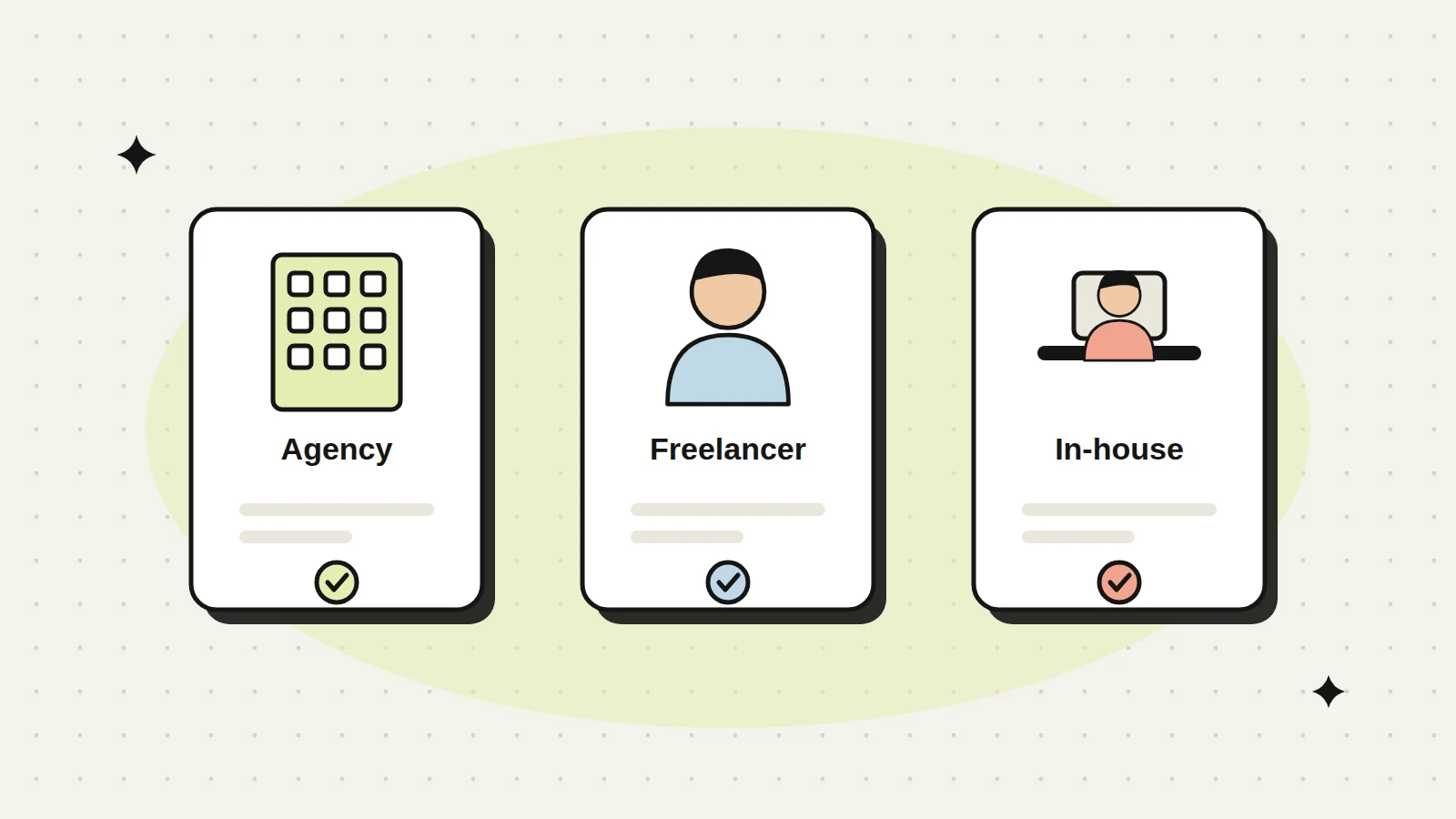
You need a new website. Maybe the old one looks dated, maybe sales keeps saying it does not help them, or maybe you are about to raise money or enter a new market. Now comes the real question: who should build it? A freelancer, an agency, or someone you hire in-house?
Each option can work well. Each can also go badly wrong. This guide walks through the honest trade-offs on cost, speed, risk, SEO and what happens after launch, so you can pick the option that fits your company right now, not the one that sounds best in a sales call.
- Pick a freelancer when the scope is small and clear, you have someone in-house to manage the project, and budget is tight.
- Pick an agency when the website must bring in leads, needs strategy, design, content and SEO together, and you want one team accountable for the result.
- Pick in-house when you ship website changes every week and can afford a full-time salary plus tools and training.
- Many B2B companies do best with a mix: an agency for the rebuild, then an in-house marketer or a small retainer for ongoing work.
- Whatever you pick, decide who owns the site, the hosting and the content before any work starts.
The three options in plain words
First, what each option actually means, because the labels get used loosely.
- Freelancer: one person, usually a designer or a developer, sometimes both. You talk directly to the person doing the work.
- Agency: a team with separate people for strategy, design, development, content and SEO, plus a project lead. Agencies range from three people to three hundred, so “agency” alone tells you little about size or quality.
- In-house: you hire one or more people on your payroll to build and run the website. In B2B, this is often a marketing generalist or a web developer who also handles other digital work.
The honest truth is that the person matters more than the label. A great freelancer beats a weak agency every time. But the structure of each option does create predictable strengths and weak spots, and those are worth knowing before you sign anything.
Side by side: cost, speed, risk and support
Here is a simple comparison for a typical B2B marketing website: 15 to 40 pages, a few service or product pages, case studies, a blog and a contact form that feeds your CRM.
| Freelancer | Agency | In-house | |
|---|---|---|---|
| Upfront cost | Usually lowest | Usually highest | Salary from day one, plus tools |
| Speed to launch | Fast for small sites, slow if they get busy | Steady, runs on a plan | Slow at first while the hire ramps up |
| Skills covered | Usually one or two | Strategy, design, build, content, SEO | Depends on who you hire |
| Key person risk | Higher: one person, one illness, one new job | Lower, if work is truly shared across a team | Medium: what if they leave? |
| After-launch support | Depends on their schedule | Usually a retainer or support plan | Always available, within their skills |
| SEO and lead focus | Often thin unless they specialize | Should be built in, ask to see how | Only if you hire for it |
| Who manages the project | Mostly you | Their project lead, with your input | You, fully |
Notice that the cheapest option on paper often needs the most of your time. If your marketing head spends ten hours a week chasing a freelancer, that cost is real, it just does not show up on an invoice.
These are typical patterns, not rules. A specialist freelancer with strong SEO skills can do better than a small agency, and a two-person studio may work more like a freelancer than a full agency. Judge each option on the actual people, their written process and the support they commit to in the contract.
When a freelancer is the right choice
Freelancers get a bad name because of a few horror stories, but plenty of good B2B websites are built by one skilled person. A freelancer is a smart choice when:
- The site is small, for example a 5 to 10 page site for a new company or a single product launch.
- You already have your brand, your messaging and your copy ready. The freelancer only has to design and build.
- Someone on your side can manage the project, give feedback quickly and make decisions.
- You have seen their past work and it is close to what you need, in quality and in type of business.
Where it goes wrong: the freelancer is a great designer but a weak developer (or the other way round), nobody thinks about SEO, the site launches without proper redirects from the old URLs, and six months later the freelancer has moved on to a full-time job. Then nobody knows how the site was built.
If a freelancer hosts the site on their own account and you do not have admin access, fix that before you pay the final invoice. Your domain, hosting and CMS logins should be in your company’s name.
Tell us your goals and we will give you an honest view, even if it is not us.
When an agency is the right choice
An agency costs more because you are paying for a team and a process. That is worth it when the website has a bigger job to do than look good. Choose an agency when:
- The website needs to bring in inquiries, not just exist. That means messaging, page structure, SEO and conversion all have to be planned together.
- Your positioning is not fully clear yet and you need help working out what to say, to whom, and in what order.
- You sell something technical, like engineering services, industrial equipment or B2B software, and the site must explain it to both buyers and engineers.
- You need several skills at once: brand refresh, copywriting, design, development, SEO, maybe product videos.
- You do not have time to manage five separate people and stitch their work together.
Where it goes wrong: you get passed to a junior team after the sales meeting, the agency pushes a template it uses for everyone, or the project is “done” at launch and nobody looks at whether it brings in leads. Ask who exactly will work on your account, and what happens in the three months after launch. Our website agency checklist has the questions to ask.
For a sense of what a full-scope build covers, see how we approach B2B website development: strategy and structure first, then design and build, then SEO and tracking so you can see what is working.
When building in-house makes sense
Hiring in-house sounds like the most control for the money. Sometimes it is. In-house works best when:
- You change the website every week: new landing pages for campaigns, new case studies, product updates, events.
- You already have a working site and need someone to run it, not rebuild it from zero.
- You can afford a proper salary and are ready to train and keep that person.
- You have a marketing leader who can guide their work and review it.
The catch is that one hire rarely has every skill. A good developer may not write good copy. A good marketer may not know technical SEO. And if your only web person leaves, you are back to square one, often with a site only they understood.
A pattern that works well: a specialist team handles the rebuild, then an in-house marketer keeps it fresh, with the agency on call for bigger changes.
The SEO question most buyers forget
A new website can lose search traffic you spent years building. This is the most common and most expensive mistake in B2B redesigns, and it happens with all three options.
Before you choose anyone, ask them how they handle these four things:
- URL mapping and redirects: every old page that gets traffic or links must point to the right new page (see Google’s site move guide).
- Page structure: each important service, product or industry should have its own page, written for the way buyers search.
- Technical basics: page speed, clean code, sitemap, schema, mobile layout, and correct indexing on launch day.
- Tracking: form submissions, calls and key clicks set up in analytics from day one, so you can see leads, not just visitors.
AI search adds a new layer. Google says its AI features have no special requirements beyond normal good SEO (Google’s guidance on AI features), and other AI tools do not publish their rules. Clear answers, proper headings and real expertise help people and search engines alike, so they are a sensible base for AI answers too. If a builder has never thought about this, that tells you something. Our SEO and lead generation work starts during the website build for exactly this reason.
“Show me a site you rebuilt where search traffic held or grew after launch, and tell me what you did to protect it.” A confident, specific answer is a good sign.
Cost: what drives the number
We are not going to give you a magic price, because honest quotes depend on scope. But it helps to know what moves the number up or down, whichever option you pick.
- Number of unique page templates, not total pages. Twenty case studies on one template cost far less than twenty unique pages.
- Who writes the copy. Good B2B copy takes interviews, research and rewrites. If it is included, the quote goes up, and it should.
- Integrations with your CRM, marketing automation, job portal, product database or customer login.
- Content migration from the old site, especially blogs, PDFs and resources.
- Custom illustration, photography, animation or video.
- Languages and regions if you sell in more than one market.
In the quotes we see, a freelancer is often cheaper than an agency for the same page count, though not always, and the scope is rarely identical, and an in-house hire costs a full year of salary whether the site is finished in three months or twelve. Compare total cost over 12 to 18 months, including your own team’s time, not just the first invoice.
A simple way to decide
Answer these five questions honestly. Your answers will usually point clearly to one option.
- Is the main job of this website to bring in leads? If yes, lean towards an agency or a very experienced freelancer with SEO skills.
- Is your messaging clear and written down? If no, you need strategy help, which usually means an agency.
- Who on your side will manage the project, and how many hours a week can they give? Fewer hours means you need more management from the builder.
- How often will the site change after launch? Weekly changes point to in-house or a retainer.
- What happens if the main person on the project disappears for a month? If that would be a disaster, avoid single points of failure.
Some common situations, and what usually fits:
| Your situation | Usually fits best |
|---|---|
| New company, 5 to 10 pages, copy ready, someone to manage it | A good freelancer |
| Site must bring leads, messaging unclear, several skills needed | An agency |
| Working site, weekly changes, a marketing lead in place | An in-house hire |
| Big rebuild now, small steady changes later | Agency for the build, then in-house or a small retainer |
| Tight budget but search traffic matters | A freelancer with proven SEO migrations, or a phased agency scope |
If you are a manufacturer, an engineering firm or a B2B tech company, the site often has to do heavy lifting for sales, because buyers research quietly before they ever call. In those cases, a team that understands your sector helps. You can see the kind of work we do for manufacturing companies and look at live sites like JER HR Group, CompBldr, SecMark and Cornext on our work page.
Questions to ask before you sign
Whatever you choose, these questions protect you:
- Who exactly will work on my project, and can I speak to them before signing?
- What is included, and what will cost extra? Ask for it in writing.
- Who owns the design files, the code, the CMS account and the domain after launch?
- How do you handle SEO during the move from our old site?
- What does support look like in the first 90 days, and after that?
If you want a second opinion on your options, even if you end up hiring a freelancer or building in-house, we are happy to talk it through. Start a conversation with us and tell us what the website needs to do for your business.
Frequently asked questions
Straight answers about working with us.
Is an agency always better than a freelancer for a B2B website?
No. A skilled freelancer can build an excellent site if the scope is clear and your copy and brand are ready. An agency is better when the site needs strategy, content, design, development and SEO working together, or when you cannot manage the project yourself.
How long does a B2B website take with each option?
A small site with a freelancer can take a few weeks. A full agency build with strategy, copy and SEO usually takes two to four months depending on scope and how fast feedback comes back. In-house builds take longer at first because the new hire needs time to learn the business.
Can I hire a freelancer for design and an agency for SEO?
You can, but someone has to own the whole thing. Split teams often blame each other when traffic drops or leads do not come in. If you split the work, make one person responsible for the final result and get SEO involved before design starts, not after.
What should I own at the end of a website project?
You should own your domain, hosting account, CMS account, design files and all content. The builder can have access, but the accounts should be in your company’s name. Put this in the contract so there is no argument later.
Should I keep the agency after launch?
Only if they will keep adding value, for example SEO, new landing pages, content and conversion work tied to leads. If you only need small text edits, an in-house person or a light support plan is usually enough.
When does a freelancer make sense for a B2B website?
For a small, simple site with a clear brief and limited budget, when you can manage the project and content yourself.
When is an in-house team the right choice?
When the website changes constantly and you can keep designers, developers and writers busy full time.
What does an agency offer over a freelancer?
A full team of strategy, copy, design, development and SEO, plus cover when someone is away, which matters for bigger sites.
How do costs compare between the three?
Freelancers usually cost least upfront, in-house teams cost most over a year, and agencies sit in between with a fixed scope.
Can we mix the options?
Yes. Many companies keep one in-house marketer and use an agency or freelancers for specialist work.
How do we decide which option suits us?
Compare your budget, how often the site changes and who will manage the work. Hypergrow can help you scope it, even if the answer is not an agency.
Keep reading
More on websites.
 Websites5 min readB2B Website Redesign Checklist for Marketing Leaders
Everything to check before, during and after a B2B website redesign, so you protect search traffic, avoid scope gaps and launch on time.
SSabesh12 Feb 2026 Websites9 min readWebsite RFP Template for B2B Companies: What to Include and Why
A section-by-section website RFP template you can copy, plus the common brief mistakes that cause bad agency quotes.
SSabesh9 Jan 2026 Websites10 min readWebflow vs WordPress for B2B: Which to Pick for Your 2026 Site
A fair, practical comparison of Webflow and WordPress for B2B marketing websites, from a team that builds on both.
VVinoth6 Jan 2026Start a conversation
Not sure who should build your site?
Tell us your scope and team. We will tell you honestly whether a freelancer, an agency or a hire fits best.